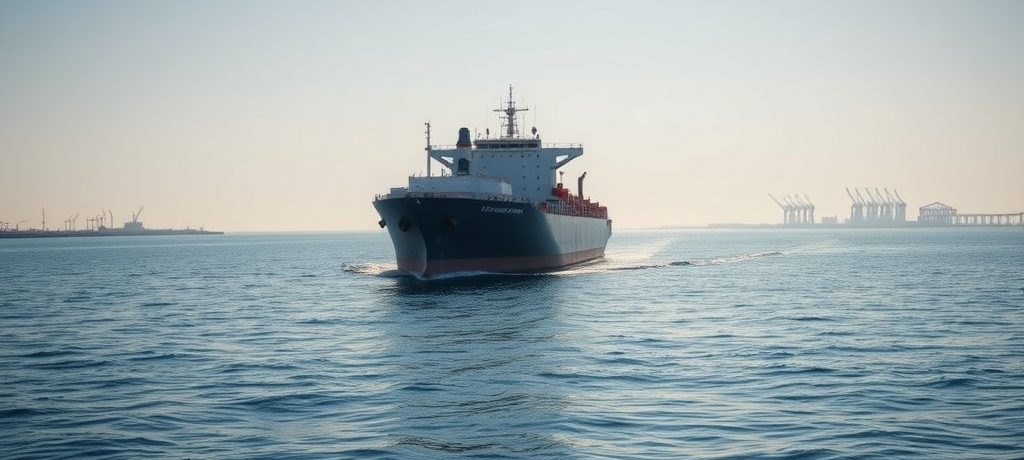
Crude oil prices experienced a sharp decline on Thursday, reversing an earlier surge, after U.S. President Donald Trump announced a peace deal with Iran and subsequently recalled orders for a military offensive. The unexpected diplomatic breakthrough, communicated via his social media platform Truth Social, immediately eased heightened geopolitical tensions that had gripped energy markets for days.
West Texas Intermediate (WTI) crude oil for July month delivery was last observed trading down by $2.81, representing a 3.12% decrease, settling at $87.22 per barrel. This significant drop underscores the market’s sensitivity to developments in the U.S.-Iran relationship, particularly concerning the critical Strait of Hormuz, a vital artery for global oil shipments.
Geopolitical Tensions Precede Deal
The de-escalation comes on what would have been day 104 of the U.S.-Iran conflict, a period marked by escalating rhetoric and direct military engagements that had kept global energy markets on edge. Just days prior, President Trump had signaled optimism for a deal, assuring market participants that a U.S.-Iran agreement would materialize swiftly and that the Strait of Hormuz, a vital chokepoint for global oil transit, would reopen, thereby alleviating significant supply concerns.
However, the path to peace was fraught with renewed hostilities. On Tuesday, an Iranian action to down a U.S. Apache helicopter patrolling the Strait of Hormuz ignited fresh fury, escalating tensions dramatically. President Trump vowed a ‘fierce’ response, expressing profound displeasure over Iran’s perceived stalling in negotiations and asserting unequivocally that Iran would ‘pay for the delay.’ This was quickly followed by U.S. forces striking several targets within Iran, prompting a swift and coordinated counter-retaliation from Iran, which attacked U.S. bases in Bahrain, Jordan, and Kuwait. The exchange of attacks continued for a second day, with President Trump announcing via his social media platform, Truth Social, that Iran would be ‘hit very hard tonight’ and that U.S. forces intended to ‘take over the control of Iran’s Kharg Island.’
He drew a direct parallel to the U.S. takeover of Venezuelan oil trade through a ‘short and sudden military offensive months before,’ stating the U.S. would ‘assume total control of Iran’s oil and gas markets.’ In response, Iran’s top military command, Khatam al-Anbiya Central Headquarters, issued a stark warning, declaring that Iran would ‘ensure there will be oil and gas for all or else for none.’ Despite these aggressive postures and the imminent threat of a major offensive, Trump had also reiterated in an interview with Fox News that while he ‘always preferred the U.S. takeover of Kharg Island,’ he was ‘unsure if the U.S. citizens could withstand a major escalation,’ even as talks with Iran continued. These increasing war concerns had previously pushed oil prices upwards, as traders, anticipating supply disruptions, avoided significant market moves that might expose them to further volatility.
Sudden Diplomatic Breakthrough
The dramatic and unexpected shift occurred just hours before the planned strikes were set to commence. President Trump again took to Truth Social, declaring a pivotal breakthrough: ‘the highest level of Iranian leadership and neighboring countries of Iran have approved the final draft of a deal with the U.S.’ Consequently, he announced the immediate ‘calling off’ of the planned military offensive, a decision that instantly reverberated through global financial markets. While the ‘time and place of signing will be announced shortly,’ Trump stressed that the ‘naval blockade on Iranian ports will remain in force until the deal is formally signed.’
The immediate consequence of this announcement was a profound reversal in oil market sentiment. Prices, which had been buoyed by war fears, gave ground rapidly and turned lower as the prospects of the Strait of Hormuz reopening and the potential for increased Iranian supply grew significantly brighter. This sudden pivot highlights the extreme sensitivity of crude oil prices to geopolitical developments in the Middle East, particularly those affecting critical shipping lanes and major oil-producing nations.
OPEC Report and Iran’s Production Impact
Further contributing to the market’s re-evaluation of supply dynamics, the Organization of Petroleum Exporting Countries (OPEC) released its monthly report, lowering its forecast for global oil demand growth for 2026 to 970,000 barrels per day. The report highlighted the severe impact of the ongoing U.S. naval blockade on Iranian ports, noting that Iran’s crude production ‘nosedived more than 18%’ last month. Specifically, Iran’s output plummeted by 546,000 barrels per day, reaching 2.33 million barrels per day. This data underscores the significant supply constraint that the blockade has imposed, a factor that could change if the peace deal leads to its eventual lifting, potentially adding substantial barrels back into the global market.
In broader market movements, the U.S. dollar index was last seen trading at 99.85, registering a decrease of 0.20 points, or 0.20%, during today’s trading session.
The abrupt pivot from impending military action to a confirmed peace deal has profoundly reshaped the immediate outlook for crude oil markets. While the formal signing and the lifting of the naval blockade remain pending, President Trump’s announcement has significantly reduced the geopolitical risk premium embedded in oil prices. The market’s swift reaction reflects the critical role of the U.S.-Iran relationship in global energy supply, particularly concerning the unimpeded flow of oil through the Strait of Hormuz, even as the broader implications for Iran’s reintegration into global oil markets await further clarity.