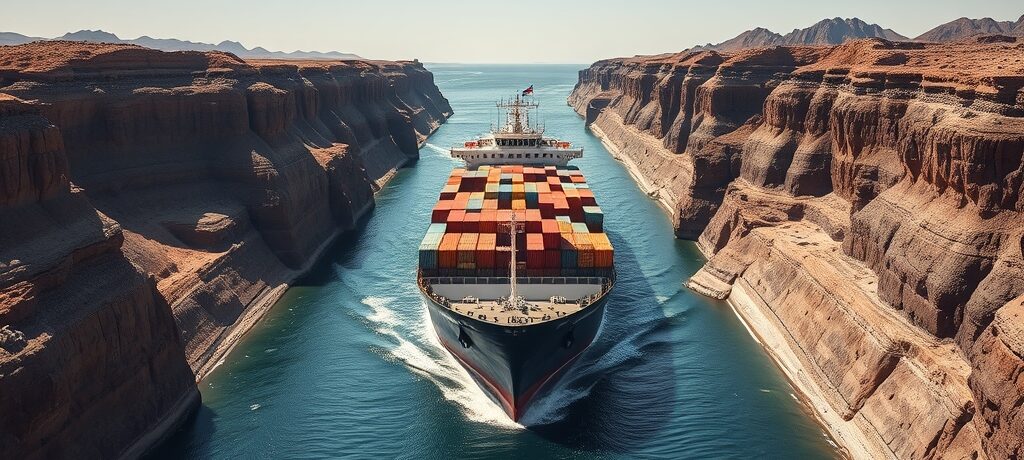
A French-owned vessel has successfully traversed the Strait of Hormuz, marking a significant development more than a month after the US-Israeli war with Iran effectively halted normal transport activity through the critical global shipping lane. The Malta-flagged container ship, owned by French company CMA CGM, completed its passage on Friday, a detail confirmed by media organisation BFM TV, which is owned by the shipping company. CMA CGM, however, declined to comment on the matter.
This transit represents the first instance of a ship owned by a major Western European firm navigating the strait since the conflict’s onset, according to confirmation from shipping analysts Kpler. While Iran has publicly stated that ‘non-hostile vessels’ are permitted to use the waterway, the ongoing conflict has been characterized by several ship attacks, contributing to a dramatic slowdown in maritime traffic.
Strategic Waterway Reopens Cautiously
Tracking data indicated that the French-owned ship maintained a course unusually close to the coast of Oman, positioned on the opposite side of the waterway from Iran. The specific cargo being transported by the vessel remains undisclosed. In a related development, a Japanese ship carrying natural gas also managed to exit the Strait of Hormuz, with Japanese shipping giant MOL confirming the safety of its vessel and all crew members. MOL reiterated its commitment to prioritizing the safety of its crew, cargo, and vessels in ongoing operations.
Observations from maritime news and intelligence service Lloyd’s List noted that several ships making the journey through the strait on Thursday similarly hugged ‘unusually close’ to the Omani coastline, suggesting a pattern of heightened caution. The geopolitical tensions surrounding the strait have drawn comments from US President Donald Trump, who expressed frustrations with allies for not providing assistance in reopening the route. On Truth Social, Trump stated, “With a little more time, we can easily OPEN THE HORMUZ STRAIT, TAKE THE OIL, & MAKE A FORTUNE. IT WOULD BE A ‘GUSHER’ FOR THE WORLD???”
Economic Repercussions and Global Impact
The Strait of Hormuz is a choke point of immense global economic importance, facilitating the transport of approximately a fifth of the world’s oil and liquid natural gas from the Gulf countries. The suspension of shipping activity, which began in late February following the conflict’s escalation, left an estimated 200 vessels stranded in the surrounding waters, as reported by Lloyd’s List.
The dramatic slowdown in traffic through this narrow waterway has had significant economic ramifications, contributing to skyrocketing global oil prices. This, in turn, has led to rising fuel prices for consumers and fueled fears of higher inflation across international markets. Despite the severe reduction in activity, shipping through the strait has not entirely ceased. Data analyzed by BBC Verify in late March revealed that approximately 100 vessels have managed to pass through the Strait of Hormuz since the conflict began, averaging about five to six ships per day.
This current traffic level represents a substantial decline of about 95% compared to pre-conflict volumes. Of the vessels that have transited, roughly a third had links to Iran, while others were associated with countries such as Pakistan and India. The passage of the French-owned CMA CGM ship, therefore, offers a cautious indication of a potential, albeit limited, resumption of commercial shipping for major international firms through this vital maritime artery, even as global economic concerns persist regarding the strait’s long-term stability and accessibility.