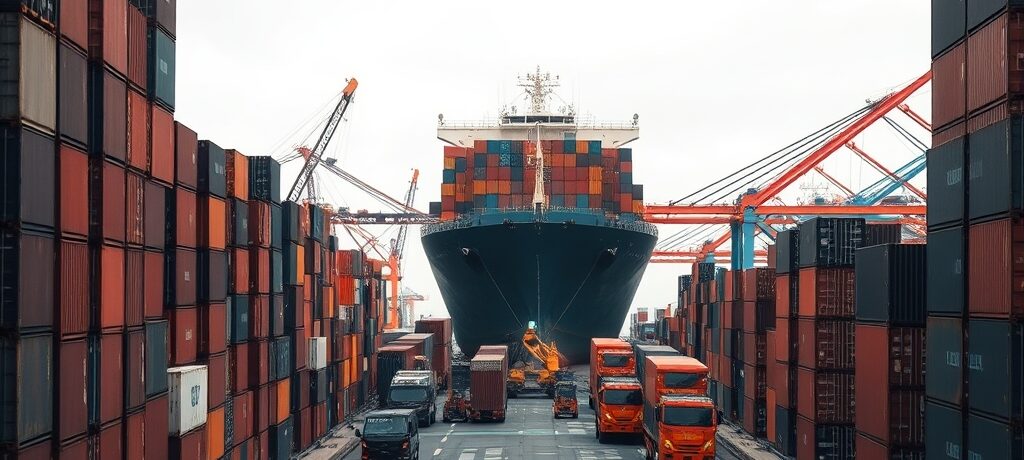
President Donald Trump announced Friday his administration will escalate tariffs on cars and trucks imported from the European Union to 25% starting next week. The move, which Trump stated is a response to the EU’s alleged non-compliance with a previously agreed trade deal, carries the potential to significantly disrupt the global economy at an already delicate juncture.
The decision marks a sharp increase from the existing tariff structure and challenges the framework established by the Turnberry Agreement. This trade deal, named after Trump’s golf course in Scotland, was initially brokered last July between President Trump and European Commission President Ursula von der Leyen. It had set a tariff ceiling of 15% on most goods exchanged between the U.S. and the EU, a framework both parties had previously affirmed their commitment to preserving.
However, the status of the 2025 agreement faced uncertainty earlier this year following a Supreme Court ruling. The court determined that the Republican president lacked the legal authority to declare an economic emergency for the purpose of levying tariffs on EU goods. This judicial intervention subsequently reduced the administration’s tariff authority from the initial 15% ceiling to 10%, prompting the launch of new import taxes based on alternative legal statutes.
In his recent post, President Trump accused the EU of ‘not complying with our fully agreed to Trade Deal.’ While the President did not elaborate on the specific nature of these objections, the accusation serves as the stated justification for the impending 25% tariff hike. This unilateral action could reignite trade tensions and introduce considerable uncertainty into transatlantic economic relations.
The impending tariff increase on European automotive imports comes as global economic conditions remain fragile. The escalation of trade disputes, particularly involving such a significant sector and major economic blocs, risks creating ripple effects across supply chains and consumer markets, potentially impeding broader economic recovery efforts.