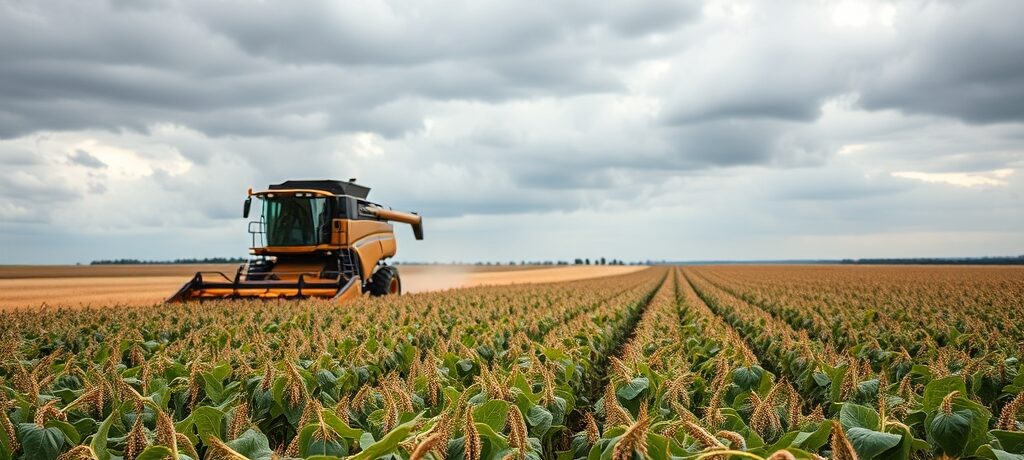
Midwest soybean farmers are grappling with a complex array of financial pressures, as rising input costs, a persistent global supply glut, the lingering effects of a trade war, and recent geopolitical instability combine to squeeze profit margins. Doug Bartek, a 60-year-old fifth-generation farmer near Wahoo, Nebraska, articulated the widespread anxiety at the onset of the spring planting season, citing high costs for fuel, equipment, and fertilizer, compounded by tariffs and the Iran war.
Bartek, who chairs the Nebraska Soybean Association, highlighted the drastic increases in operational expenses. “Our biggest struggles are our inputs, be it fertilizer, seed, chemical, parts,” Bartek stated, adding, “There has been so much drastic markup in all of these. And I just kind of feel like the farmer’s kind of painted in the corner.” These concerns are echoed across the region, with Justin Sherlock, a soybean farmer and president of the North Dakota Soybean Growers Association, noting, “A lot of producers are pretty nervous going into this year. It looks like we’re going to have another year of negative returns.”
Input Costs Soar Amid Global Glut
The financial strain on soybean producers is exacerbated by persistently low commodity prices. Chad Hart, an agricultural economist at Iowa State University, explained that global soybean production has consistently set new records, leading to an oversupply. “If we look at global soybean production over the past several years, it continues to set record, after record, after record,” Hart said. This glut has driven down prices, even as Brazil surpassed the U.S. as the world’s largest soybean producer years ago, intensifying competition.
Simultaneously, farmers’ operating costs continue their upward trajectory. The U.S. Department of Agriculture reports that overall farm production expenses, including seed and pesticide, have increased over time. Specifically for soybean production, operating costs have remained elevated since 2020 and are projected to rise further in 2026. Beyond direct inputs, land costs present another significant challenge. Joana Colussi, a research assistant professor at Purdue University, noted that Midwest cropland values have increased, and most regional farmers rent a portion of their land. Bartek, who rents three-quarters of his 2,000-acre farm, confirmed that landowners are increasing rents, adding to the financial burden. “There’s a lot of what I call absentee landowners that have absolutely no idea what goes on on the farm,” he said.
Tariffs’ Enduring Impact on Export Markets
The trade war initiated by the Trump administration in April 2025, which saw sweeping tariffs levied against China, created significant disruption for U.S. soybean farmers. China, historically the top buyer of U.S. soybeans, responded with retaliatory tariffs and effectively boycotted U.S. soybeans, causing prices to collapse and forcing farmers to sell at a loss or hold onto their crops. Mike Cerny, a farmer in Sharon, Wisconsin, recalled, “When that was announced and soybean prices basically collapsed, if you could afford to hold on to your beans and wait for better times, you were OK. If you had a mortgage due or payments due or cash flow needs and you had to sell at that point, you were taking it pretty rough.”
Although the U.S. and China reached a deal in late 2025, with Beijing committing to purchase 12 million metric tons of soybeans by January and at least 25 million metric tons annually for the next three years, the damage has been lasting. The Trump administration also rolled out a $12 billion temporary aid package in December. However, experts and farmers contend these measures have not fully offset losses. The American Soybean Association reported that even after federal assistance, farmers still lost almost $75 per harvested acre of soybeans in the 2025 crop year. Joseph Glauber, former chief economist at the Department of Agriculture, highlighted how the trade war pushed China toward competing exporters like Brazil, accelerating a trend of declining U.S. soybean exports. “We’re still feeling the impacts today. When you look at where soybean exports are today versus where we would normally expect them to be, we’re still running anywhere from 15% to 20% behind normal,” Hart added.
Geopolitical Instability and Supply Chain Disruptions
Recent geopolitical events have introduced another layer of complexity. Following attacks by the U.S. and Israel on Iran on February 28, shipping traffic through the Strait of Hormuz experienced a severe slowdown. This disruption led to a surge in oil prices and significantly restricted the export of nitrogen fertilizers manufactured in the Persian Gulf, sending the price of urea, a vital nitrogen fertilizer, skyrocketing. While soybeans do not require nitrogen fertilizer, most soybean farmers also grow corn, which is highly dependent on it. About half of the global urea supply originates from the Middle East, with Qatar and Saudi Arabia being key sources for U.S. imports, according to the American Farm Bureau Federation.
A two-week ceasefire agreement announced on April 7 offered hope for reopening the Strait of Hormuz, but traffic remained slow amid ongoing disagreements. While many farmers purchased fertilizer in advance, those who did not are facing elevated prices. Dave Walton, Vice President of the American Soybean Association, noted in March that some neighbors, lacking cash flow, struggled to budget for fertilizer due to the high costs. Seth Goldstein, a senior equity analyst at Morningstar, warned that the war and strait closure would have lasting impacts, citing damage to critical facilities in the Middle East and an impending “big supply crunch in commodity chemicals.”
These compounding issues create a significant liquidity cash crunch for many Midwest farmers, as described by Paul Mitchell, a professor at the University of Wisconsin-Madison. The long-term trend of farm consolidation, driven in part by these financial pressures, means that larger farms, which rely on expensive machinery, require greater financial reserves. Hart emphasized, “The financial reserves need(ed) on a farm are much greater than they used to be. We’re a bit more sensitive to the financial conditions these days because so much capital is being utilized within the farm business.” The confluence of global market forces, trade policy, and geopolitical conflict presents an exceptionally challenging and uncertain environment for Midwest soybean producers.