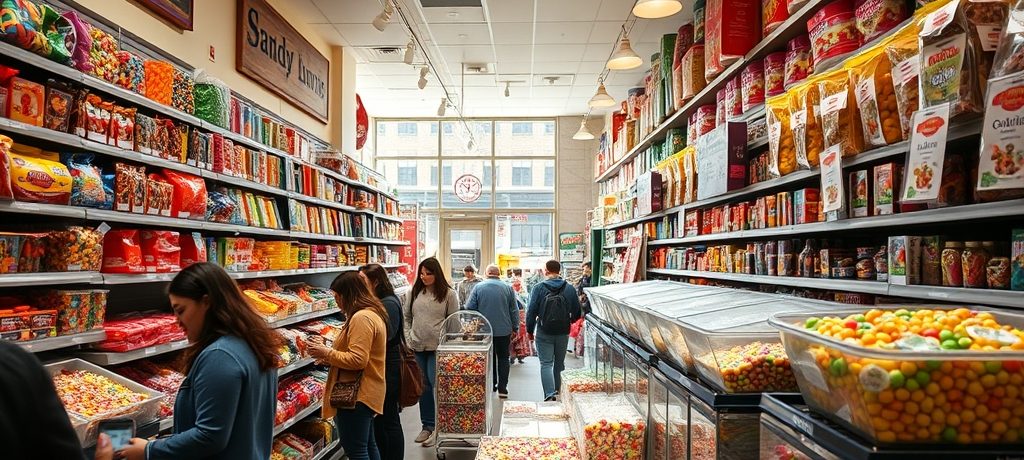
In a stark contrast to the prevailing economic gloom gripping the United States, New York City’s candy stores are experiencing a sweet surge, with several businesses expanding and new ones set to open. This resilience in a sector often considered discretionary spending highlights a unique consumer behavior pattern during times of financial uncertainty.
Sweet Treats as an Affordable Indulgence
Mitchell Cohen, third-generation owner of Economy Candy on Manhattan’s Lower East Side, believes that candy remains a staple purchase even when economic times are tough. “The dollar isn’t going as far these days,” Cohen stated. “Inflation, uncertainty, all that, but there’s always candy.” His family’s business, established in 1937 during the Great Depression, initially sold candies from a cart outside a hat and shoe repair shop. When repairs became unaffordable, the business pivoted entirely to sweets, a strategy that has sustained it for 89 years.
This sentiment is echoed by Kate Bolger, who is preparing to open The Village Confectionery in Sleepy Hollow, New York. Bolger, a former movie producer, observes that consumers may postpone large, expensive purchases but can still afford to treat themselves to a piece of candy. This phenomenon aligns with the ‘lipstick effect’ economic theory, which suggests that during economic downturns, consumers opt for small, affordable luxury items instead of significant splurges.
Recent data indicates that while US retail sales saw a 4.9% increase in April year-over-year, consumer sentiment in May hit a new all-time low according to a closely watched report. Bolger notes that candy’s low price point makes it accessible to a broad range of consumers, allowing “everyone to partake” despite economic pressures.
Expansion and New Entrants in the Sweet Sector
The expansion is not limited to established businesses. BonBon, an upscale candy store company founded by three Swedish expatriates in 2018, now operates five shops across Manhattan and Brooklyn, with an additional location in the Hamptons. The company imports its products from Sweden, known for its strict regulations on natural ingredients and a recent surge in global popularity driven by social media. BonBon co-founder Leo Schaltz emphasizes a strategic approach to site selection, avoiding high-traffic main avenues for quieter side streets with lower rents. He also highlights the advantage of smaller retail spaces, which can be made to feel more intimate and cozy, and the importance of “little, quirky details” like staff uniforms inspired by Stockholm restaurants.
Further evidence of this trend is the opening of Candy King, a Swedish sweet shop chain, which launched its first US outlet in Manhattan in December. In Brooklyn, Cat Cirino’s Candor Candy’s, located in the Fort Greene neighborhood, opened in March. Cirino has diversified her offerings to include pantry items like granola, rice, soft drinks, and beef jerky from independent producers to boost revenue. However, she also benefits from candy’s inherent advantages: a long shelf life, room temperature storage, and the efficiency of the pick-and-mix model where customers handle much of the selection process.
Navigating Supply Chain Challenges
Despite the positive growth, the candy industry faces its own set of challenges. Mitchell Cohen of Economy Candy points to rising wholesale prices for confectionary supplies, many of which are imported. These increases are attributed to former President Trump’s import tariffs and escalating global transport costs, exacerbated by fuel price hikes linked to geopolitical conflicts. Cohen notes that a Hershey chocolate bar, which cost his shop around 62 cents pre-pandemic, now exceeds a dollar, as cocoa beans, even for American brands, are sourced internationally. He also mentioned a UK supplier who ceased shipping to the US due to losses incurred from customs procedures.
Nevertheless, Cohen reports that Economy Candy has absorbed most of these cost increases, and sales are up. He reiterates the core principle: in these difficult economic times, “a little candy goes a long way.” This enduring appeal of affordable indulgence continues to sweeten the economic outlook for New York’s confectionery retailers.