China’s economic expansion faltered significantly in the second quarter, with gross domestic product (GDP) figures revealing a 4.3% growth rate between April and June. This figure falls below Beijing’s annual target and represents a notable slowdown from the 5% expansion recorded in the first quarter. The deceleration was primarily attributed to subdued domestic demand and the inflationary pressures stemming from the Iran war’s impact on oil prices, which overshadowed robust export performance.
Exports Show Strength Amidst Domestic Weakness
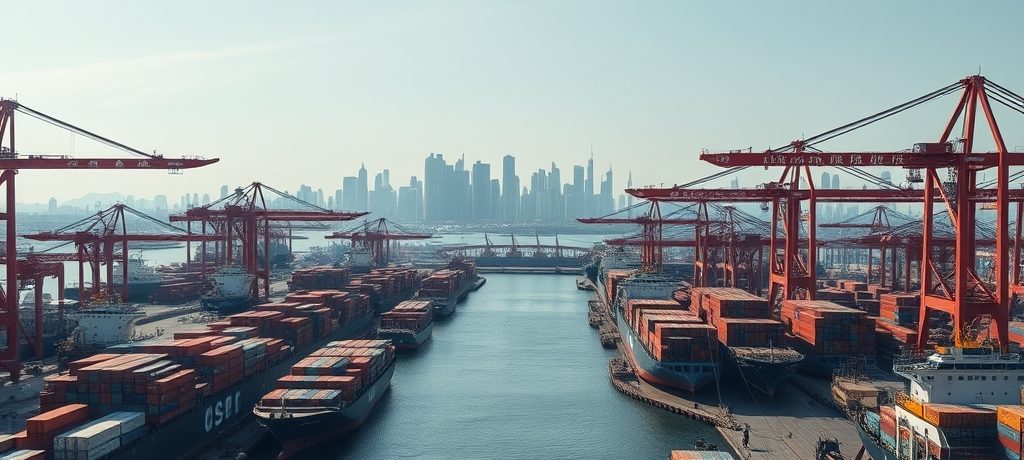
The latest official GDP data, released on July 15, 2026, paints a mixed picture of the world’s second-largest economy. While domestic headwinds persisted, China’s exports demonstrated considerable strength, jumping by 27% in June compared to the previous year. This export surge was partly fueled by soaring global demand for semiconductors essential for artificial intelligence (AI) data centres and a significant increase in electric vehicle (EV) exports, which surpassed one million units for the first time in June.
Beijing Adjusts Growth Expectations
In March, China revised its annual economic growth target downwards to a range of 4.5%-5%, the lowest expansion goal set since 1991. Analysts suggest this adjustment provided Beijing with more latitude to acknowledge existing economic vulnerabilities. The second-quarter GDP figures mark the first full quarterly data release since the Iran war began on February 28, and represent the slowest quarterly expansion since China emerged from its stringent Covid-19 restrictions at the end of 2022.
Domestic Demand and Inflationary Pressures
The National Bureau of Statistics acknowledged the challenging economic environment, citing “more external instability and uncertainty factors.” The bureau also highlighted an imbalance between strong supply and weak domestic demand. Recent data released on Wednesday underscored these domestic challenges, including a protracted property market slump and sluggish consumer spending. While new home prices continued to contract, the 0.1% fall in June was a marginal improvement from the previous month. Retail sales, however, showed a modest uptick, rising by 1% in June after a 0.6% decrease in May.
Analyst Perspectives on the Slowdown
Fabien Yip, a market analyst at investment platform IG, observed that Chinese businesses are absorbing increased energy and raw material costs due to insufficient consumer demand. “The situation will become more difficult to manage the longer the Iran war goes on,” Yip stated.
Conversely, Julian Evans-Pritchard, head of China economics at Capital Economics, suggested that the slowdown might be less about a sudden deterioration and more about the revised national growth target allowing for a more realistic acknowledgment of economic conditions. “This may largely represent a greater willingness to acknowledge pre-existing weakness rather than a sudden deterioration in underlying growth,” he commented, noting that the official figure now aligns more closely with Capital Economics’ own growth estimates. Evans-Pritchard added that the June data, showing improvements across various indicators, offered some reassurance.
The interplay between strong export performance, driven by global tech and automotive trends, and the persistent weakness in domestic consumption and the property sector will continue to shape China’s economic trajectory in the coming quarters.