Walmart is set to channel tariff refunds into price reductions across its stores, a strategic move aimed at alleviating the financial strain on consumers increasingly burdened by escalating fuel costs. Executives at the retail giant confirmed this intent on Thursday, May 21, highlighting a discernible shift in shopper behavior indicative of growing economic anxiety, particularly among lower-income demographics.
Strategic Price Investment Amid Consumer Stress
The decision to invest tariff refunds directly into lower store prices marks a significant tactical pivot for Walmart. Chief Financial Officer John David Rainey articulated this strategy on an earnings call, stating, “We think that the single best return that we can have on a dollar of capital right now is to investment in the customer, invest in price.” This commitment comes as the U.S. government commenced refunding tariff payments to importers. These refunds stem from higher customs fees that were imposed by President Trump last year before the Supreme Court subsequently struck down most of them. Walmart now stands as the largest retailer to publicly suggest that it will utilize these substantial refunds for potential price cuts, signaling a direct response to consumer financial pressures.
Rainey’s comments underscore a proactive approach to maintaining customer loyalty and driving traffic. He noted that Walmart’s stores and gas stations have already observed an increase in shoppers actively seeking deals, suggesting that price sensitivity is a growing factor in consumer purchasing decisions across various product categories.
Shifting Consumer Habits Signal Financial Strain
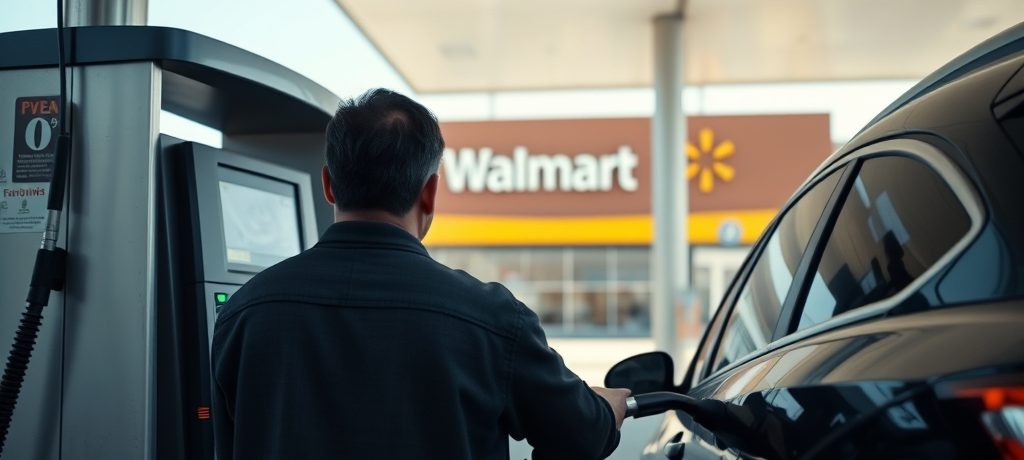
Evidence of consumer distress is becoming increasingly apparent, particularly at the pump. Rainey revealed a telling statistic: for the first time since 2022, visitors to Walmart’s gas stations have begun filling up with fewer than ten gallons of fuel. “That’s an indication of stress,” he observed, painting a clear picture of how rising costs are forcing households to ration essential purchases and manage their budgets more meticulously.
Further elaborating on the bifurcated consumer landscape, Rainey observed a stark contrast in spending patterns: “the high-income customer is spending with confidence,” while “the lower-income consumer is more budget-conscious and perhaps navigating financial distress.” This divergence highlights the uneven impact of current economic pressures across different income brackets, with Walmart’s core customer base, often comprising lower to middle-income households, feeling the brunt of inflationary trends most acutely.
Broader Economic Headwinds and Inflationsdruck
The backdrop to Walmart’s strategic shift is a challenging economic environment marked by persistent inflation and geopolitical instability. The average U.S. price of regular gas stood at $4.56 per gallon on Thursday, according to AAA, representing a substantial increase of $1.38 from a year ago. This significant surge in fuel costs is a primary driver of the broader inflationary trend, with U.S. inflation having jumped to its highest level in three years in April, largely propelled by energy prices.
Geopolitical events are exacerbating these pressures. The U.S. war with Iran has reportedly snarled tanker passage through the Strait of Hormuz, a vital corridor for global shipments of both fuel and fertilizer. The disruption in this critical waterway directly impacts the supply chain and, consequently, the prices of energy and agricultural products globally. Walmart executives have warned that these persistently high gas costs, if unchecked, will inevitably translate into higher prices for a wide array of goods on store shelves, further squeezing consumer budgets already under pressure.
Retail Sector Performance and Cost Absorption
Despite these pervasive challenges, the retail sector has shown some resilience in certain areas. U.S. sales at Walmart grew 4.1% from February through April. Federal data indicates that spending at retail stores and online collectively grew 5.2% in April compared to a year earlier, a figure that notably surpassed inflation. This suggests that while consumers are spending more in nominal terms, partly due to higher prices, they are also buying more items in some categories. However, spending at gas stations surged a remarkable 21%, almost entirely driven by the escalating cost of fuel rather than increased consumption volumes.
Rival retailers, including Home Depot, Target, and Lowe’s, also reported sales growth in their latest quarters. Executives from these companies, who held earnings calls this week, suggested that slightly larger tax refunds received by shoppers this year have helped to offset some of the budget pain experienced by consumers, providing a temporary cushion against rising costs.
Major retailers have, to date, largely absorbed their growing transportation and shipping costs. Walmart, for instance, reported a “notable hit” to its income due to higher fuel expenses, indicating the significant financial burden these costs impose on corporate profitability. This absorption strategy is becoming increasingly unsustainable, prompting companies to explore alternative measures. Home Depot executives, for example, indicated on Tuesday that their company might use its own tariff refunds to directly offset mounting fuel costs, rather than immediately passing them on as price reductions for consumers, highlighting a different approach to managing the same economic pressures.
Walmart’s decision to leverage tariff refunds for direct price cuts underscores the intensifying battle for consumer dollars in an inflationary environment. As fuel costs continue to exert pressure on household budgets and corporate bottom lines, retailers are compelled to innovate their strategies, with direct price investment emerging as a key tactic to retain and attract budget-conscious shoppers and mitigate broader economic headwinds.