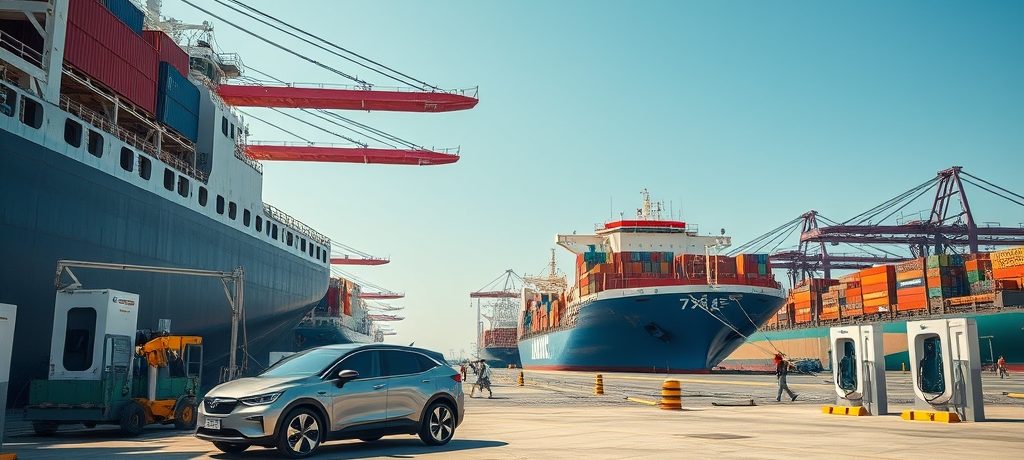
HONG KONG — Geopolitical tensions, specifically the war in Iran and the resulting blockade of the Strait of Hormuz, have fundamentally reshaped the global electric vehicle (EV) market. This disruption, which affected approximately a fifth of the world’s crude oil and liquified natural gas shipments, first impacted Asia and then Africa, pushing fuel prices to unprecedented levels and accelerating the shift towards electric mobility, particularly in developing economies.
Chinese Automakers Capitalize on Market Shift
The surge in fuel costs has created a significant opening for Chinese automakers. Global exports of Chinese EVs reached a record $9.4 billion in April, according to an analysis by the think tank Ember, based on Chinese customs data. This momentum continued into May, with China exporting approximately 435,000 passenger EVs and plug-in hybrids, more than double the figure from a year earlier, as reported by the Chinese Association of Automobile Manufacturers. Shipments have surged to diverse markets including Australia, Brazil, Southeast Asia, and East Africa.
Chinese automakers supplied around 60% of electric cars sold globally, according to the International Energy Agency (IEA), actively targeting Europe, Africa, and Latin America for expansion. Jerry Gan, CEO of Geely Auto, one of China’s largest automakers, stated at a company event in March that the group plans to “accelerate (our) overseas expansion” over the next five years, making inroads into regions like Southeast Asia.
Economic Imperatives Drive Adoption
The primary driver for consumers is financial savings. As fuel prices climb, drivers are increasingly switching to EVs to reduce personal expenses. Nguyen Thien Bao, an EV motorbike driver in Hanoi, Vietnam, noted, “Before, so much of my income went into fuel. Now, I can actually save some money.” This sentiment is particularly acute in regions where transport constitutes a large portion of household spending, such as South Africa, where it accounted for nearly a fifth of household expenditure in 2024, according to a Stellenbosch University study.
Governments, too, are embracing electrification to curb oil imports and reduce the burden of fuel subsidies. Laos, for instance, banned the import of fuel-powered vehicles for the remainder of 2026 to cut oil import costs and encourage the EV transition. Ethiopia has also banned non-EV imports, signaling a strong commitment to electrification.
The global interest in EVs is evident in sales figures. One in four new cars sold worldwide last year were electric, according to the IEA. This trend is expected to continue, with global electric car sales projected to reach 23 million in 2026, comprising nearly 30% of all cars sold worldwide.
The Lagging Charging Infrastructure
Despite the rapid adoption and import of EVs, charging infrastructure development is significantly lagging. Paul Gong, head of UBS bank’s China automotive industry research, described this as a “classic chicken-and-egg problem” where the lack of sufficient charging infrastructure hinders fleet growth, and vice versa. Gong suggested that “government support for infrastructure could help accelerate adoption.”
Specific regional examples highlight the challenge:
- Thailand: With over 424,000 battery EVs and plug-in hybrids, the country has approximately 4,600 public charging locations, equating to roughly one charger for every 92 vehicles, according to the Electric Vehicle Association of Thailand. The IEA reports around 12,000 public chargers. Drivers like Yutthana Samranwong in Phitsanulok province describe booking public charging ports as a “headache,” leading some in Bangkok to consider returning to fuel-powered cars.
- Ethiopia: Despite its import ban on non-EVs, the country had only about a dozen charging stations as of mid-2025. The government estimates a need for over 1,170 stations, with 40 currently under construction in the capital, Addis Ababa.
- Malaysia: Public fast chargers increased by more than 70% in 2025, spurred by government incentives, including tax breaks for operators meeting specific investment criteria.
- Indonesia: The state-owned power utility PLN has deployed more than 4,500 public charging stations.
The Role of State-Owned Utilities
In many developing markets, state-owned utilities are stepping up to address the infrastructure gap. This model, particularly prevalent in Africa, is seen by analysts as a potential blueprint for other emerging markets. “Utilities are recognizing that electric mobility will become a meaningful source of future electricity demand,” said Ndia Magadagela, co-founder and CEO of Everlectric, a South African commercial EV leasing company.
Africa currently has around 2,000 public EV charging stations, with South Africa accounting for the largest share. Kenya Power, a state-controlled utility, plans to build 44 charging stations within the next year. Chris Liu, with the technology research and advisory group Omdia, noted that building these networks is challenging due to issues like grid connections and maintenance. He added that while large Chinese automakers like BYD are expanding charging networks in some regions, they may have less incentive to build extensive infrastructure outside China. Therefore, state-owned utilities, with their close ties to national grid planning, electricity pricing, and distribution capacity, are poised to play a crucial role in supporting an even larger EV fleet size.
The rapid acceleration of EV adoption, driven by economic necessity and geopolitical shifts, underscores a critical imbalance. While Chinese automakers are successfully meeting the demand for affordable electric vehicles, the foundational infrastructure required to sustain this transition remains a significant hurdle, necessitating continued public investment and strategic planning to ensure long-term viability and widespread electrification.