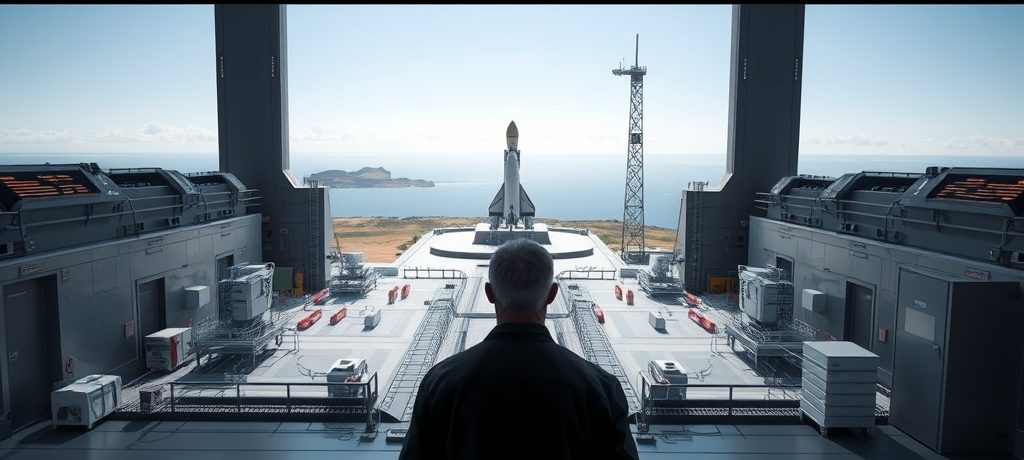
Portugal is rapidly positioning itself as a significant player in the burgeoning European space economy, driven by strategic investments in human capital and infrastructure. At the heart of this ambition is the construction of a new spaceport on the remote Azores island of Santa Maria, slated to become a cost-effective launch and landing site for smaller satellites within the European Union. This initiative marks a considerable modernization effort, aiming to leverage the nation’s engineering prowess and unique geographic advantages to carve out a specialized niche in the global space race.
Building a Spacefaring Nation
The Portuguese Space Agency, established in 2019, is spearheading the nation’s push into the extraterrestrial domain. Ricardo Conde, President of the agency, highlights the foundational strength: “Portugal has modernized considerably over the past 20 years. Our universities produce outstanding engineers. We have created human capital that we can build on.” This investment in talent is already yielding tangible results, with approximately 80 different companies now employing some 2,000 highly qualified workers across Portugal’s space industry. Last year, the sector generated a turnover of €200 million ($232.5 million), with even greater productivity anticipated for the current year, according to Conde.
A key “trump card,” as Conde describes it, is the Azores archipelago. The Atlantic islands offer a strategically advantageous location for space operations, particularly for safe ocean landings.
The Santa Maria Spaceport: A European Complement
The spaceport under development on Santa Maria is not intended to rival massive facilities like the US’s Cape Canaveral. Instead, Bruno Carvalho of spaceport operator ASC clarifies its role: “It is much smaller and more of an addition to the European Kourou spaceport in French Guiana.” The focus is on becoming “a cost-effective launch site for smaller rockets with smaller satellites, within the EU, which is strategically important.” Its remote Atlantic location ensures that spacecraft can safely land in the ocean, mitigating risks to populated areas.
Operations at the spaceport are projected to involve 35 personnel once fully established, reflecting a more compact and economical model compared to larger international sites. Ivo Vieira of space industry group AED Cluster Portugal notes the significance, stating, “This will be a big deal.” The European Space Rider spaceplane is scheduled to land there in 2028, utilizing the island’s old, rarely used World War II-era runway. A rocket launch, carrying a South Korean satellite into orbit, is planned for 2030. Already, several satellite communication antennas are operational on Santa Maria.
Beyond its primary function, the spaceport aims to foster local economic growth. Carvalho expresses hope that the initiative “could strengthen the local economy” and “bring back young people who have left the island,” by tapping into local resources.
Portugal’s Compact Satellite Strategy
Parallel to infrastructure development, Portugal is actively cultivating its satellite manufacturing capabilities. Ricardo Conde confirms that “Three Portuguese centers are developing them.” These include the CEiiA consortium in Porto, the Open Cosmos multinational at the University of Coimbra, and a third facility in Lisbon, which primarily collaborates with the armed forces.
The strategy emphasizes compact, specialized satellites for diverse applications, including commercial, military, and mixed uses such as communications, Earth and ocean observation, and wildfire fighting. Andre Dias, responsible for CEiiA’s downstream division, explains their focus: “We are specializing in small satellites that cost between €20 and 30 million, not the big ones that can cost up to €500 million.” CEiiA, which entered the space sector in 2018, aims to develop an industry for high-resolution satellites. The consortium currently has the capacity to build four civilian satellites, weighing up to 500 kilograms, annually, and plans to increase production capacity by a factor of four or five through a new research and development facility near Guimaraes.
This specialization reflects a broader trend, with Dias observing a “democratization of space travel” as smaller countries like Portugal carve out niches alongside larger European space nations.
Reusable Capsules and International Collaboration
The Azores spaceport is also attracting international interest for its landing capabilities. Marta Oliveira, co-founder of the German space logistics firm ATMOS Space Cargo, humorously describes her venture as “the FedEx of space,” aiming to deliver satellites to orbit at low cost using reusable capsules. Portuguese authorities have already approved “the first EU splashdown for the Phoenix 2.1 transport space capsule,” which could occur later this year. Oliveira notes that “ASC spaceport facilitating logistics and coordinating with the local authorities, which is ideal for us,” highlighting the collaborative potential.
Portugal’s ambitions extend to a significant presence in orbit, with Ricardo Conde stating, “We will have 30 satellites in space by 2030, some of them in collaboration with Spain.” This goal underscores a commitment to international partnerships and building on European initiatives, including in the increasingly important military sector.
Portugal’s deliberate and focused approach to space development, combining strategic infrastructure with specialized satellite manufacturing and international cooperation, positions it as a dynamic new entrant in the global space economy. By leveraging its geographic assets and skilled workforce, the nation is not merely reaching for the stars but building a sustainable, economically viable pathway to becoming a recognized spacefaring nation.