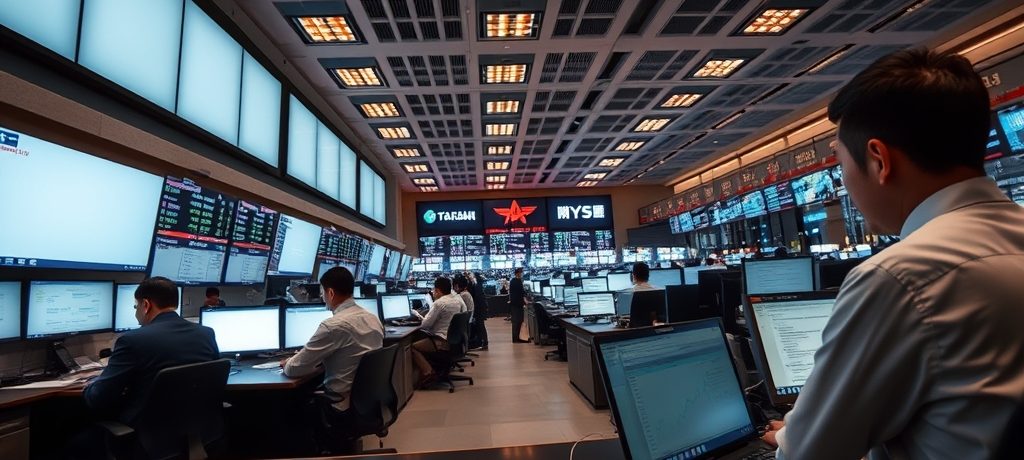
The Taiwan Stock Exchange (TSE) is bracing for a further decline, having already moved lower in two of the past three trading days following a brief two-day winning streak that saw it gain almost 300 points or 0.7 percent. This recent downturn has seen the index shed previous gains, now resting just above the 41,170-point plateau, with expectations for a lower open on Monday amidst a challenging global economic backdrop. The market’s recent performance reflects broader negative sentiment driven by surging oil prices, persistent ambiguity surrounding the conflict in the Middle East, and escalating concerns over the trajectory of interest rates.
TSE’s Recent Performance and Sectoral Shifts
The TSE concluded Friday’s session sharply lower, stumbling by 579.44 points, or 1.39 percent, to finish at 41,172.36. This significant single-day loss followed a trading range between 41,016.73 and 42,408.66. The market’s decline was primarily attributed to losses observed across the plastic and cement sectors. In contrast, technology stocks presented a mixed performance, while financial shares offered some degree of support, preventing a more severe downturn.
Individual Stock Movements on Friday
A closer examination of Friday’s active stocks reveals a varied landscape across key sectors. Among financial institutions, Cathay Financial saw a notable gain of 1.56 percent, Fubon Financial collected 1.59 percent, Mega Financial rose 0.25 percent, CTBC Financial perked 0.16 percent, and E Sun Financial added 0.31 percent. However, First Financial shed 0.68 percent.
In the critical technology sector, Taiwan Semiconductor Manufacturing Company (TSMC) experienced a slight dip of 0.22 percent, while United Microelectronics Corporation jumped 1.85 percent and Hon Hai Precision rallied 1.64 percent. Largan Precision was a standout performer, skyrocketing 9.89 percent. Conversely, several tech firms faced significant pressure: Catcher Technology tanked 2.89 percent, MediaTek plunged 4.26 percent, Delta Electronics crashed 3.71 percent, and Novatek Microelectronics plummeted 5.38 percent.
The struggling plastic and cement sectors saw Formosa Plastics sink 0.87 percent and Asia Cement tumble 2.41 percent, with Nan Ya Plastics remaining unchanged.
Global Market Context and Wall Street’s Influence
The negative sentiment pervading the Asian markets is largely a reflection of a bleak lead from Wall Street, where major averages opened lower on Friday and remained firmly in the red throughout the trading day, ultimately concluding at session lows. This downturn in the U.S. market mirrored similar declines observed across European markets, collectively setting a cautious precedent for Asian bourses.
Specifically, the venerable Dow Jones Industrial Average tumbled 537.33 points, or 1.07 percent, to finish the week at 49,526.17. The technology-heavy NASDAQ Composite plunged a more significant 410.05 points, or 1.54 percent, closing at 26,225.14, while the broader S&P 500 index sank 92.74 points, or 1.24 percent, to end at 7,408.50. Despite Friday’s sharp sell-off, the weekly performance for U.S. indices showed marginal movements, indicating a week of mixed trading leading up to the Friday decline. The S&P managed a slight gain of 0.1 percent for the week, while the NASDAQ eased 0.1 percent, and the Dow slipped 0.2 percent, highlighting the volatility and indecision that characterized the trading period.
Drivers Behind Wall Street’s Decline
The pronounced sell-off on Wall Street was primarily attributed to widespread profit taking, a natural reaction following a period of robust strength that had recently propelled both the NASDAQ and S&P 500 to achieve record highs. Technology shares, which had been instrumental in driving this recent market rally, notably led the markets lower during Friday’s session, indicating a rotation or re-evaluation by investors. Adding a significant layer of pressure to the equity markets was a sharp increase in treasury yields. The yield on the benchmark 10-year note surged to its highest levels in almost a year, a development closely watched by investors. This rise in yields came on the heels of recent economic data that has shown significant accelerations in the pace of both consumer and producer price inflation. Such inflationary signals have intensified concerns among market participants about the prospective outlook for interest rates, leading to speculation about potential monetary policy tightening by central banks, which typically dampens equity valuations.
Crude Oil Prices Add to Global Anxieties
Further exacerbating global market anxieties were surging crude oil prices. West Texas Intermediate crude for June delivery rose by $4.18, or 4.13 percent, to reach $105.35 per barrel on Friday. This significant increase was triggered by the conclusion of the U.S.-China summit without any announcement of Chinese intervention to resolve the Gulf War, consequently leaving the critical Strait of Hormuz blockade in place. The ongoing geopolitical instability and its direct impact on global energy supplies continue to cast a shadow over investor confidence.
As the Taiwan Stock Exchange prepares for another potentially challenging trading day, the confluence of domestic sector-specific weaknesses and powerful global headwinds—from inflationary pressures and interest rate uncertainty to geopolitical tensions and rising energy costs—suggests a continued period of caution for investors. The market’s ability to find sustained support will likely hinge on clearer resolutions to these macroeconomic and geopolitical uncertainties.