President Trump has once again threatened to dismiss Federal Reserve Chairman Jerome Powell, whose term is slated to conclude in a month. The president’s latest remarks, made during an interview with Fox Business that aired on Wednesday, cited Powell’s performance as ‘doing a bad job’ and asserted that ‘He should be lowering interest rates.’ This renewed threat comes as a contentious Justice Department investigation into the central bank continues, potentially complicating the path for Trump’s nominee to replace Powell.
Renewed Threats and Legal Ambiguity
The president’s repeated attempts to remove the Fed chairman have consistently raised questions regarding his legal authority to do so. Legal scholars and precedent suggest that such a dismissal would require a showing of serious wrongdoing, a standard not yet met. The Supreme Court is currently weighing a related case following Trump’s prior attempt to fire Lisa Cook, a member of the Fed’s governing board. The high court has allowed Cook to remain in her position while that case is pending, underscoring the legal complexities surrounding presidential authority over the independent central bank.
Powell’s term as Fed chairman is set to expire in mid-May. Despite the looming deadline and the president’s public criticisms, Powell has affirmed his commitment to remain in his post until a successor is confirmed. ‘That is what the law calls for,’ Powell told reporters last month. ‘And that’s what we’re going to do in this situation.’ This stance signals a potential for Powell to remain in leadership longer than anticipated, especially given the ongoing controversies.
The Justice Department’s Controversial Probe
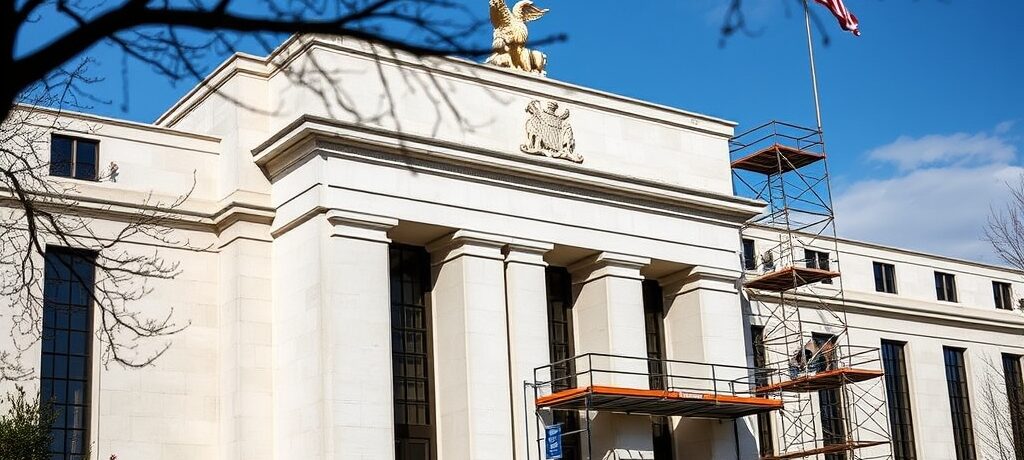
Central to this escalating conflict is an ongoing Justice Department investigation into alleged cost overruns associated with the Federal Reserve’s headquarters renovation project. While ostensibly a probe into financial irregularities, a federal judge recently cast significant doubt on its true intent. Last month, a federal judge ruled that these cost overruns are a ‘mere pretext,’ concluding that the real purpose of the Justice Department’s probe is to intimidate the central bank.
Judge James Boasberg, in a decision quashing subpoenas related to the investigation, wrote, ‘The Government has offered no evidence whatsoever that Powell committed any crime other than displeasing the President.’ He further stated, ‘There is abundant evidence that the subpoenas’ dominant (if not sole) purpose is to harass and pressure Powell either to yield to the President or to resign and make way for a Fed Chair who will.’ This judicial rebuke highlights the extraordinary nature of the executive branch’s pressure on the independent institution.
Despite the judge’s ruling, prosecutors have not backed down. The Wall Street Journal and The New York Times reported that two prosecutors made a surprise visit to the Fed’s headquarters construction site on Tuesday, April 14, 2026. NPR has not independently confirmed this visit. This continued pursuit of the investigation, despite judicial skepticism, indicates a persistent effort to maintain pressure on the Federal Reserve and its chairman.
Powell’s Stance and Potential Delays for Successor
Beyond his commitment to stay until a successor is confirmed, Powell also has the option to remain on the Fed’s governing board until 2028. He has indicated he will not step down from the board until the Justice Department resolves its probe of the headquarters renovation project. This position could significantly delay the transition of leadership at the central bank, creating an unprecedented situation where a former chairman remains a voting member of the board while his successor takes the helm.
The ongoing investigation and the judicial findings could also backfire on the president by delaying the confirmation of Kevin Warsh, Trump’s proposed nominee to serve as the next Fed chair. A key member of the Senate Banking Committee, Republican Thom Tillis of North Carolina, has publicly stated that he will not vote to confirm Trump’s nominee until the Justice Department’s probe is resolved. The committee is scheduled to hold a hearing on Warsh’s nomination next week, setting the stage for a potentially contentious process.
Political Implications and Trump’s Resolve
During his interview with Fox Business, President Trump explicitly stated he would not instruct prosecutors to drop their probe of the Federal Reserve. ‘Don’t you think we have to find out what happened there?’ the president questioned, signaling his intent to continue the investigation despite the controversies and potential political fallout. This stance suggests a prolonged battle between the executive branch and the central bank, with significant implications for the Fed’s independence and market stability.
The confluence of an expiring term, a legally challenged presidential authority, a judicially criticized federal investigation, and a determined incumbent chairman creates a highly volatile situation for the nation’s central bank. As the Senate Banking Committee prepares for Warsh’s nomination hearing next week, all eyes will be on Washington to see how these unprecedented tensions resolve, or further escalate, in the coming weeks.