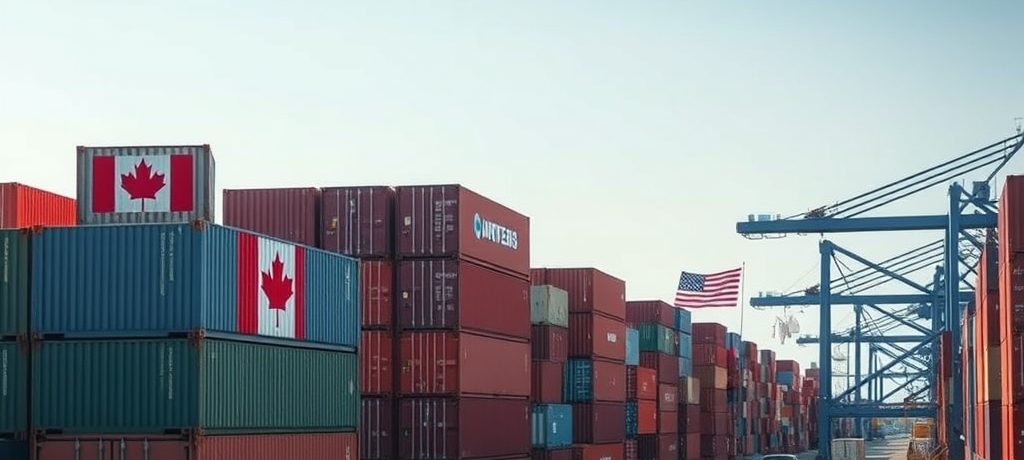
US President Donald Trump has enacted a 50% tariff on a broad spectrum of goods imported from Canada, effective in 30 days, in a move that significantly intensifies trade tensions between the two North American neighbours. The duties, announced on July 20, 2026, target everyday consumer items such as wine and hockey sticks, alongside industrial goods like cement, according to reports.
However, several critical Canadian exports have been spared from the new duties, including energy, potash, critical minerals, and fish. Canadian Prime Minister Mark Carney swiftly responded to the announcement, stating that Canada stands ready to “intensify” trade talks with the United States in the coming weeks.
Underlying Grievances Drive Escalation
The White House justified the tariffs as retaliation for what President Trump termed “unequal treatment” of US cars, dairy, and alcohol. These new duties apply to all covered goods, irrespective of their inclusion under the existing free trade agreement between Canada, the US, and Mexico, known as the USMCA.
Prime Minister Carney, in a statement on X, characterized the tariffs as “the latest in a series of unilateral US trade actions that began with the US imposing a series of tariffs in direct violation of the Canada-United States-Mexico Agreement.” He also referenced “threats to Canadian sovereignty,” a possible allusion to President Trump’s past calls for Canada to become the 51st US state.
The executive orders signed by President Trump on Monday did not mention Canadian wildfire smoke, a previous point of contention, but instead focused on long-standing trade irritants. These include:
-
Automotive Sector: Trump accuses Canada of levying a tax on US motor vehicles and parts not covered by USMCA, deeming it “unreasonable” and discriminatory, as Canada reportedly does not charge similar taxes to other nations. The automotive manufacturing sector in North America is highly integrated, yet US Commerce Secretary Howard Lutnick has previously asserted that Canada should “come second” to the US.
-
Dairy Industry: Canada’s supply management system, which restricts foreign imports and imposes tariffs upwards of 300% on quantities exceeding set limits, has been a persistent issue for the US.
-
Alcohol Boycott: An enduring boycott of US alcoholic beverages by most Canadian provinces, initiated last year, has become a significant point of contention. Canadian premiers have indicated that this boycott would be lifted if the US removed its tariffs on key Canadian sectors, including metals and automobiles.
Building on Existing Trade Barriers
These new import taxes compound existing trade barriers between the two nations. The US has maintained active tariffs ranging from 15% to 50% on Canadian steel, aluminum, and copper. Washington also imposes a 35% tariff on Canadian softwood lumber and a 25% tax on non-US parts in cars. In response, Canada has its own 25% counter-tariff on selected imports of American steel, aluminum, and vehicles.
The legal basis for Monday’s duties is Section 338 of the 1930 Tariff Act, which addresses trade discrimination. This differs from the International Emergency Economic Powers Act of 1977, under which President Trump had previously imposed sweeping international tariffs that were struck down by the US Supreme Court earlier this year. The Supreme Court ruled that the president had exceeded his authority under a law reserved for national emergencies, prompting the White House to vow the invocation of other mechanisms for import taxes.
USMCA’s Future and Industry Reactions
Earlier this year, the US opted not to renew the USMCA in its current form, seeking changes to the agreement originally negotiated during Trump’s first term. While Canada and Mexico sought a renewal, the treaty continues to govern North American trade on a rolling basis, requiring annual reviews.
Industry leaders have voiced concerns over the escalating trade dispute. Candance Laing, head of the Canadian Chamber of Commerce, called the latest tariffs a “regrettable decision” and urged officials to make “meaningful progress” in talks before the new duties take effect. Chris Swonger, head of the Distilled Spirits Council of the United States, also called for a resolution, warning that the decision “raises the risk of further retaliation.”
As the 30-day countdown begins for the implementation of these new tariffs, the focus shifts to the upcoming trade talks. The willingness of both sides to engage constructively will determine whether this latest escalation leads to a resolution or further fragmentation of the highly integrated North American economy, with potential ripple effects across various sectors.