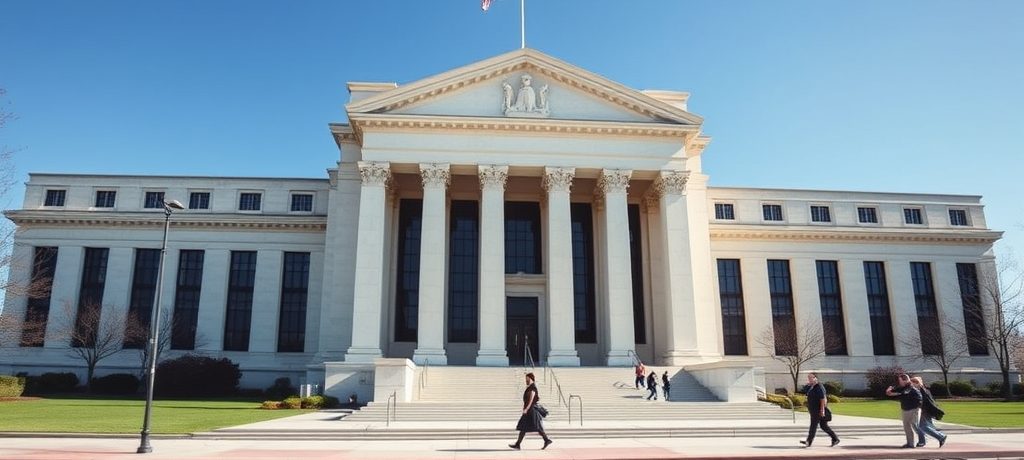
President Donald Trump’s decision to hold a swearing-in ceremony for Kevin Warsh at the White House, a departure from tradition for politically independent Federal Reserve chairs, has amplified concerns about the central bank’s autonomy. The appointment of Warsh, who secured confirmation with the narrowest majority in the Fed chair’s history—54 votes in favor to 45 against—has ignited debate over whether he will serve as an independent voice or a conduit for the president’s policy preferences.
A Contentious Confirmation
Democratic Senator Elizabeth Warren, a vocal critic, labeled Warsh a ‘sock puppet’ for Trump during his Senate confirmation hearing. Her skepticism was underscored by Warsh’s refusal to directly answer whether Donald Trump lost the 2020 election, instead stating, ‘We try to keep politics, if I’m confirmed, out of the Federal Reserve.’ Claudia Sahm, chief economist at New Century Advisors and a former Federal Reserve economist, told DW that the hearing ‘failed to dispel doubts about his independence,’ a sentiment echoed by the close confirmation vote.
High Stakes for the Central Bank
The Federal Reserve chair wields significant power, influencing interest rates that ripple through the banking sector, the dollar’s exchange rate, and the cost of goods and services in the world’s largest economy. The role demands a commitment to price stability, financial system confidence, and global economic safeguarding. President Trump has openly expressed his desire for lower interest rates, aiming to stimulate the economy ahead of midterm elections, a stance that has put pressure on the Fed’s independence.
Warsh, however, has publicly stated that Trump did not pressure him on interest rate decisions. ‘The president never once asked me to commit to any particular interest rate decision, period,’ Warsh asserted during his confirmation hearing. ‘Nor would I ever agree to do so if he had,’ the 56-year-old added.
Undermining Independence
The experience of Warsh’s predecessor, Jerome Powell, highlights the potential for presidential interference. Trump repeatedly criticized Powell for not lowering rates and even initiated a Justice Department investigation targeting him. Kenneth Rogoff, an economist and professor at Harvard University, warned that any erosion of the Fed’s independence would have ‘massive repercussions.’ He emphasized that the dollar’s central role in the global financial system means U.S. instability affects everyone. Rogoff noted that while Trump’s trade policies and actions regarding Iran have already impacted international confidence, ‘when I talk to investors and ask them what they really pay attention to, they say: the independence of the central bank.’
Background and Financial Standing
Warsh’s career includes a law degree from Harvard Law School and a stint at Morgan Stanley. He served as an economic adviser to President George W. Bush and, in 2006, was appointed to the Federal Reserve Board of Governors, becoming its youngest member at 35. During his tenure, he gained a reputation as a monetary policy ‘hawk’ for his criticism of then-Fed Chair Ben Bernanke’s ultraloose policies in response to the 2007-08 financial crisis. He departed the Fed in 2011, returning to investment banking and academia.
Warsh’s personal finances are substantial, with an estimated net worth of around $200 million (€173 million), according to the Office of Government Ethics. This is in addition to his wife’s fortune, estimated by Forbes at approximately $2 billion.
Will Warsh Resist Pressure?
With his background in central banking and Wall Street, Warsh understands the market’s sensitivity to perceptions of political influence. Rogoff cautioned that any impression that the central bank’s course is dictated by the president could lead to market instability, with investors driving up interest rates—the opposite of the government’s desired outcome. Sahm suggested that while Warsh needed to impress the president to secure the job, his current challenge is to convince financial markets and the Fed’s Board of Governors of his sound leadership. ‘It is unlikely that he will be able to satisfy everyone,’ she stated.
Recent reports indicate Warsh has voiced support for lower interest rates, aligning with Trump’s views. This position is notable given rising inflation, partly attributed to the Iran conflict and higher energy prices. Lowering rates now could stimulate the economy but exacerbate inflationary pressures. Several members of the Fed’s 12-member rate-setting committee have already expressed opposition to rate cuts, meaning Warsh would need to garner significant support to implement such a policy. Outgoing Chair Powell’s decision to remain on the Board of Governors also adds an influential voice, a stark contrast to Trump’s public criticisms of him.