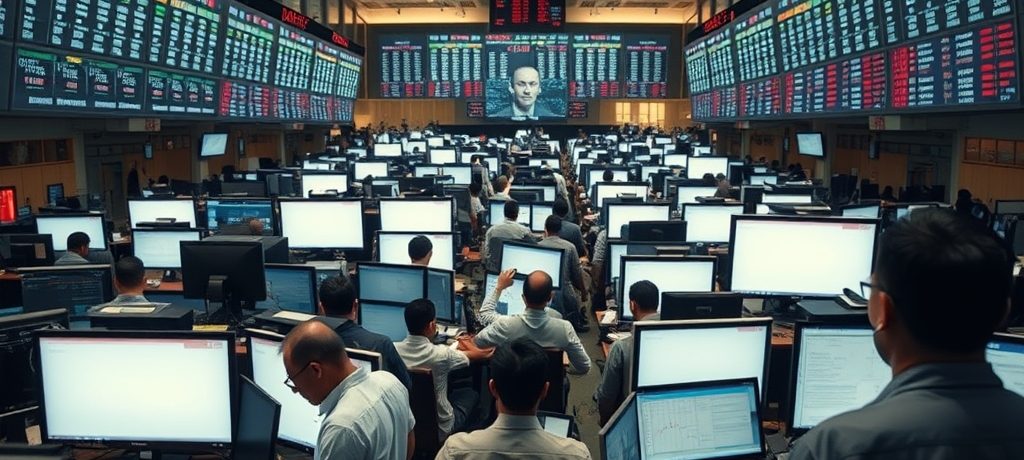
Global investors are rapidly divesting from Indonesia, initiating a widespread ‘Sell Indonesia’ strategy across trading desks as the nation’s benchmark stock index tumbles at the fastest pace worldwide and its currency sinks to historic lows. This dramatic loss of confidence follows President Prabowo Subianto’s increasingly populist and interventionist economic agenda, which has unsettled a market long accustomed to fiscal conservatism and predictability.
Just five months after reaching a record high, Indonesia’s benchmark stock index has plummeted 36%, making it the worst performer this year among over 90 global gauges tracked by Bloomberg. Concurrently, the rupiah has weakened more than 7% since its record high and has depreciated approximately 14% since President Prabowo took office in October 2024, ranking as Asia’s weakest currency this year. Foreign investors have also withdrawn billions of dollars from Indonesian bonds, signaling broad-based market anxiety and a re-evaluation of the country’s risk profile.
A Dramatic Reversal for Emerging Markets Staple
This marks a significant reversal for Indonesia, a commodities-rich country that was once a staple allocation in many emerging-market portfolios and widely perceived as friendly to foreign investors. The abrupt shift in sentiment is directly attributed to President Prabowo’s policy direction, which deviates sharply from the market-friendly approach that previously attracted long-term foreign capital and underpinned its investment-grade credit ratings. George Boubouras, head of research at hedge fund K2 Asset Management, which oversees about $4.3 billion, confirmed this prevailing trend, stating unequivocally, “The big trade in Asia ‘is sell Indonesia’.” After decades of investing in the country, Boubouras exited all positions in 2024, declaring, “I have zero exposure to Indonesia. I won’t give them an opportunity.”
Prabowo’s Interventionist Agenda Fuels Concerns
Since assuming office, President Prabowo has outlined an ambitious, yet market-worrying, economic vision. He has pledged to boost annual growth to an ambitious 8%, a target many analysts view with skepticism given current macroeconomic headwinds and the proposed policy framework. His administration has also rolled out a nationwide free school meals program, significantly expanded the state’s role in various sectors of the economy, and channeled billions of dollars into the sovereign wealth fund Danantara. More recently, a decisive move to take direct control of key commodity exports, ostensibly to curb tax evasion, triggered an immediate selloff in exporter stocks. This action, perceived by investors as government overreach, further exacerbated concerns about potential market distortions and the erosion of a free-market environment.
Fiscal Discipline Under Scrutiny
A critical turning point for many investors was the departure last year of former Finance Minister Sri Mulyani Indrawati. Widely regarded as a guarantor of fiscal discipline and a steady hand in economic management, her presence had previously reassured markets that Indonesia would maintain the conservative budget management essential for its investment-grade credit ratings and continued foreign investment. Her absence has led investors to question whether these fundamental commitments to fiscal prudence and policy predictability still hold.
Yuxuan Tang, Asia head of rates & foreign-exchange strategy at JPMorgan Private Bank in Hong Kong, articulated the broader market reaction to such shifts, noting, “Domestic political uncertainty is a typical EM risk that global investors tend to react to by staying on the sidelines until predictability re‑emerges.” Tang advised, “We still advise caution at this stage,” reflecting the widespread hesitance among institutional investors.
Rupiah’s Dire Outlook Signals Deepening Anxiety
The rupiah’s performance has become the clearest barometer of market anxiety and a focal point for bearish sentiment. The currency breached a historic 18,000-per-dollar level on Thursday, a psychological threshold that underscores the depth of its decline. Options markets signal further declines, with traders assigning approximately a 45% chance that the rupiah will fall to 19,000 by December and a 27% probability of a slide to 20,000 one year from now. This bleak outlook highlights profound concerns about Indonesia’s economic stability.
Gary Tan, a portfolio manager at Allspring Global Investments, which oversees about $624 billion, explained the underlying drivers behind the currency’s weakness: “The core driver behind shorts in Indonesia is the bearish outlook for the rupiah, where investors remain concerned about macro imbalances and policy credibility, particularly on the fiscal side.” This pressure has now extended beyond the currency market, impacting broader asset classes and contributing to the significant outflows observed in Indonesian bonds and equities.
The rapid deterioration of investor confidence underscores a fundamental re-evaluation of Indonesia’s investment appeal. The shift from a predictable, fiscally conservative environment to one characterized by populist policies and increased state intervention has prompted a significant exodus of capital. The ‘Sell Indonesia’ trade, once unthinkable for a nation rich in commodities and growth potential, has become the prevailing sentiment among a growing number of global funds, signaling a profound challenge for the new administration.
Indonesia now faces the arduous task of rebuilding trust with international investors. The current trajectory, marked by tumbling stocks, a weakening currency, and significant capital outflows, suggests that without a clear pivot back towards market-friendly policies and renewed commitment to fiscal prudence, the nation risks further isolation from the global financial community. The challenge for President Prabowo’s administration will be to balance its populist agenda with the imperative of maintaining investor confidence and macroeconomic stability, a tightrope walk that will define Indonesia’s economic future.