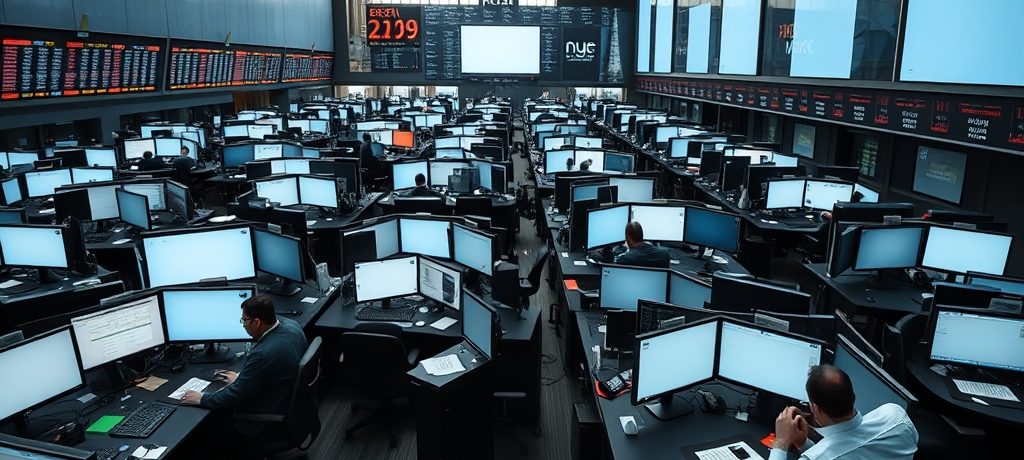
Global financial markets experienced a broad downturn today as escalating concerns over inflation, fueled by a sharp rise in oil prices, prompted investors to re-evaluate risk assets and question the sustainability of recent gains in the artificial intelligence sector. Stocks fell in tandem with government bonds, signaling a shift in market sentiment that could impact the trajectory of interest rate policies.
Equities Retreat Across Regions
The sell-off was evident across major equity indices. MSCI’s Asian share index registered a notable drop of 1.2%, while US equity-index futures slipped by 0.3% in early trading, reflecting speculation that energy costs are poised to remain elevated for an extended period. European shares were also set to open lower, with projections indicating a 1% decline at the start of trading. Concurrently, the US dollar, which has served as a preferred haven asset since the outbreak of the Middle East war in late February, extended its rally for a fifth consecutive day, underscoring investor flight to safety.
Bond Yields Climb on Inflationary Pressures
The renewed inflation concerns exerted significant pressure on government bonds, leading to a rise in yields. The Treasury two-year yield climbed three basis points to reach 4.05%, while the benchmark 10-year yield added the same amount, settling at 4.51%. In Asia, Japan’s 10-year yield saw a more pronounced jump of as much as seven basis points, following the release of data showing that producer prices in the nation had risen at their fastest annual pace since 2023, further exacerbating inflationary fears in the region.
Oil Prices and Geopolitical Tensions Drive Market Anxiety
A primary catalyst for the market’s unease was the continued ascent of crude oil prices. Brent crude extended its gains by more than 1%, trading above $107 per barrel. This surge was compounded by geopolitical uncertainty surrounding the Strait of Hormuz, a critical global shipping lane. President Donald Trump issued conflicting statements regarding the waterway, initially asserting the US did not need to reopen it, only to later state the country desired its openness. Such volatility in a key energy choke point amplifies inflation risks, particularly as oil prices above $100 a barrel are seen as a potential trigger for reigniting broader inflationary pressures, thereby reducing the likelihood of interest-rate cuts and possibly reviving the specter of further monetary tightening.
AI Rally Under Scrutiny Amid Profit Taking
The recent loss of momentum in equities marks a notable shift following weeks of robust performance. Global stocks had previously scaled successive record highs, propelled by strong corporate earnings, a resilient US economy, and widespread investor bets on the transformative potential of artificial intelligence to fuel future profit growth. However, this rally now faces scrutiny. Anna Wu, a cross asset strategist at Van Eck Associates Corp., offered a perspective on the current market dynamics, stating, “This looks more like a pause, potentially driven by profit taking and rebalancing by investors after a meaningful rally over the course of US earnings season.” Wu added, “We could see a slowdown in Asia tech rally, in the absence of meaningful new headlines.” This suggests that while the long-term AI narrative remains compelling, short-term market movements may be influenced by tactical adjustments.
US-China Summit Fails to Assuage Market Jitters
Adding to the market’s cautious tone was the perceived lack of significant breakthroughs from the bilateral summit between the United States and China. While President Trump characterized his meeting with Chinese counterpart Xi Jinping as “great,” underlying tensions persist, particularly concerning Taiwan. China, for its part, urged the swift reopening of the Strait of Hormuz and called for discussions on the Iran war. Mark Cudmore, executive editor for Markets Live at Bloomberg, highlighted the implications, noting, “The Strait of Hormuz will return to focus, with negative consequences for risk assets, now that the tailwind setup of the Trump-Xi summit is behind us. Given that recent equity gains have been both spectacular and concentrated, the pullbacks will likely be dramatic in headline numbers.” Hiroyuki Ueno, chief strategist at Sumitomo Mitsui Trust Asset Management, echoed this sentiment, observing, “The market’s unsure how to digest the US-China talks. Sure, there are signs of more economic cooperation, but what investors were really looking for in the immediate term was progress on Iran, and it doesn’t seem like there was any meaningful discussion on that.” The absence of concrete diplomatic progress on these critical geopolitical fronts further contributed to the prevailing market uncertainty.
The confluence of rising inflation fears, propelled by surging oil prices and geopolitical friction, alongside a re-evaluation of the high-flying artificial intelligence trade, has prompted a broad-based retreat across global stock and bond markets. Investors are now navigating a complex landscape where the prospects of sustained economic growth must contend with persistent inflationary pressures and the potential for central banks to maintain a tighter monetary stance for longer than previously anticipated.