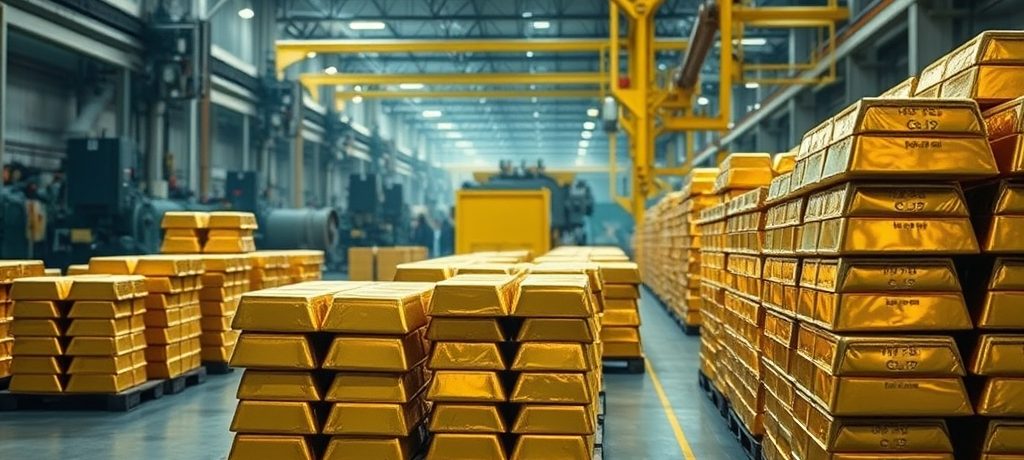
Gold prices are holding a narrow range as investors grapple with conflicting signals emanating from Federal Reserve interest rate policy and escalating geopolitical tensions in the Middle East. Renewed US airstrikes on Iran have reignited concerns over potential spikes in energy prices and a resurgence of inflation, further complicating the outlook for global monetary policy and the appeal of safe-haven assets.
n
Bullion was observed near $4,100 an ounce, showing only marginal change after experiencing a 1.4% decline in the preceding session. The latest escalation in the Middle East saw US Central Command confirm it launched “powerful strikes” in retaliation for alleged Iranian attacks on shipping in the critical Strait of Hormuz. This significant military action came just hours after Washington revoked a waiver that had previously allowed Tehran to sell oil globally, a move with direct implications for global crude supply and prices. Following these developments, crude prices advanced, signaling immediate market reaction to the heightened risk premium.
nn
Geopolitical Tensions and Inflationary Pressures
n
The immediate consequence of rising energy prices is the reinforcement of expectations that the Federal Reserve may be compelled to maintain higher interest rates for an extended period. Such a hawkish stance would be aimed at combating persistent inflationary pressures, a scenario that typically acts as a significant headwind for gold. As a non-interest-bearing asset, gold becomes comparatively less attractive when alternative investments offer elevated borrowing costs. Furthermore, a strengthening US dollar, which has advanced for a second consecutive day according to the Bloomberg Dollar Spot Index, also makes dollar-denominated bullion more expensive for international buyers, adding another layer of pressure on gold prices.
n
Market participants are keenly awaiting the release of the minutes from the Fed’s June meeting later today for fresh clues on the central bank’s interest-rate trajectory. Following that pivotal meeting, gold experienced a notable slump as new Fed Chair Kevin Warsh adopted a more hawkish tone than market participants had broadly anticipated. This shift in rhetoric suggested a firmer commitment to inflation control, even at the risk of higher borrowing costs. However, recent weaker-than-expected jobs data has since tempered the likelihood of a near-term rate cut, providing some support that pulled gold back above the critical $4,000-an-ounce threshold, indicating a delicate balance of economic indicators influencing market sentiment.
nn
Analyst Outlook and Market Dynamics
n
Carsten Menke, head of next-generation research at Julius Baer Group Ltd., underscored the market’s singular focus amidst these complex dynamics. “All the gold and silver markets care about at the moment is the question if the US Federal Reserve will raise interest rates or not,” Menke stated in a recent note to clients. Despite the prevailing concerns about inflation and geopolitical instability, Menke expressed a more tempered view on the Fed’s immediate actions, adding, “We do not expect the Fed to raise rates, as part of the inflationary pressure should turn out to be temporary.” This perspective suggests that while current pressures are real, they might not warrant an immediate, aggressive monetary tightening response from the Fed.
n
The precious metal has seen a challenging period in recent months, declining by more than a fifth since the Iran war commenced in late February. This significant downturn effectively brought a three-year bull run to an end, pushing gold into a bear market last month. The swift correction reflects a period of profit-taking and re-evaluation by investors. Despite this substantial price depreciation, there is currently little evidence to suggest that investors are actively building large-scale short positions, which would typically indicate widespread anticipation of further price declines. This absence of aggressive shorting could imply that some market participants believe the downside risk might be limited or that current prices already reflect much of the negative news.
nn
Central Bank Demand as a Structural Force
n
Counterbalancing the recent market volatility and price depreciation, central banks globally continue to demonstrate robust and consistent demand for gold. China’s central bank, for instance, significantly increased its gold purchases in June, extending its longest buying streak since at least 2015. This consistent accumulation underscores a strategic commitment to diversifying its reserves away from traditional assets, even amidst periods of price fluctuations and market uncertainty.
n
Further reinforcing this trend of institutional interest, the latest survey from the World Gold Council in June revealed that a record number of central banks anticipate increasing their gold reserves in the coming year. This widespread intent highlights a fundamental shift in reserve management strategies globally. Menke highlighted this sustained institutional interest, affirming that central-bank buying remains “the strongest structural force in the market.” He acknowledged the recent damage to market sentiment and price action, however, noting, “That said, a lot of damage has been done and it will likely take some time for the market to find its footing.” This suggests that while long-term demand is strong, short-term recovery might be gradual.
n
In early trading, spot gold edged down 0.1% to $4,101.28 an ounce at 9:05 a.m. in Singapore. Silver also slipped, declining 0.2% to $59.86 an ounce, while platinum and palladium registered declines, reflecting a broader weakness across precious metals. The Bloomberg Dollar Spot Index, a key gauge of the US currency’s strength against a basket of peers, advanced for a second consecutive day, further illustrating the complex interplay of currency and commodity markets.
n
The gold market currently navigates a complex interplay of macroeconomic data, central bank policy signals, and geopolitical flashpoints. While the immediate outlook is clouded by the potential for renewed inflation from energy price hikes and the Federal Reserve’s cautious stance on interest rates, the underlying structural demand from central banks provides a foundational support that could eventually help the metal regain its footing after a turbulent period, as investors weigh short-term risks against long-term value preservation.